Widow’s Bay season 1 ending explained by director, plus a season 2 teaser
The final episode of Widow’s Bay season 1 is cheekily titled, “We Hope You Enjoyed Your Time!” For anyone foolish enough to fall for Mayor Tom Loftis’ (Matthew Rhys) scheme to turn his cursed island town into a tourist hot spot, the answer is most likely no. (Between the cults, the sea hags, and the Michael Myers-esque slasher, this hasn’t been a very chill summer.) But for audiences watching Apple TV’s new horror-comedy show from the safety of their homes, the response is an undeniable yes. Widow’s Bay is a clear contender for best new show of 2026, and its season 1 ending proves exactly why.
A lot happens in “We Hope You Enjoyed Your Time!” Luckily, we had Widow’s Bay executive producer Hiro Murai on-hand to unpack the season finale. Murai directed episodes 1, 2, 3, 9, and 10. So he had plenty to say both about the season 1 ending and the making of the series in general. We’ll have more on the latter in another piece soon, but for now, here’s a breakdown of Widow’s Bay season 1 episode 10 with the director himself.
Warning: Full spoilers for the ending of Widow’s Bay season 1 below.
Widow’s Bay season 1 ending explained
By episode 6, we learned that the root cause of everything spooky and scary happening on Widow’s Bay is a 400-year-old deal made between the Devil and the town’s original founder, Richard Warren (Hamish Linklater), which also granted Warren immortality. In episode 7, Loftis and Wyck Crawford (Stephen Root) exhume Warren’s undead body and then kill him, presumably breaking the curse once and for all.
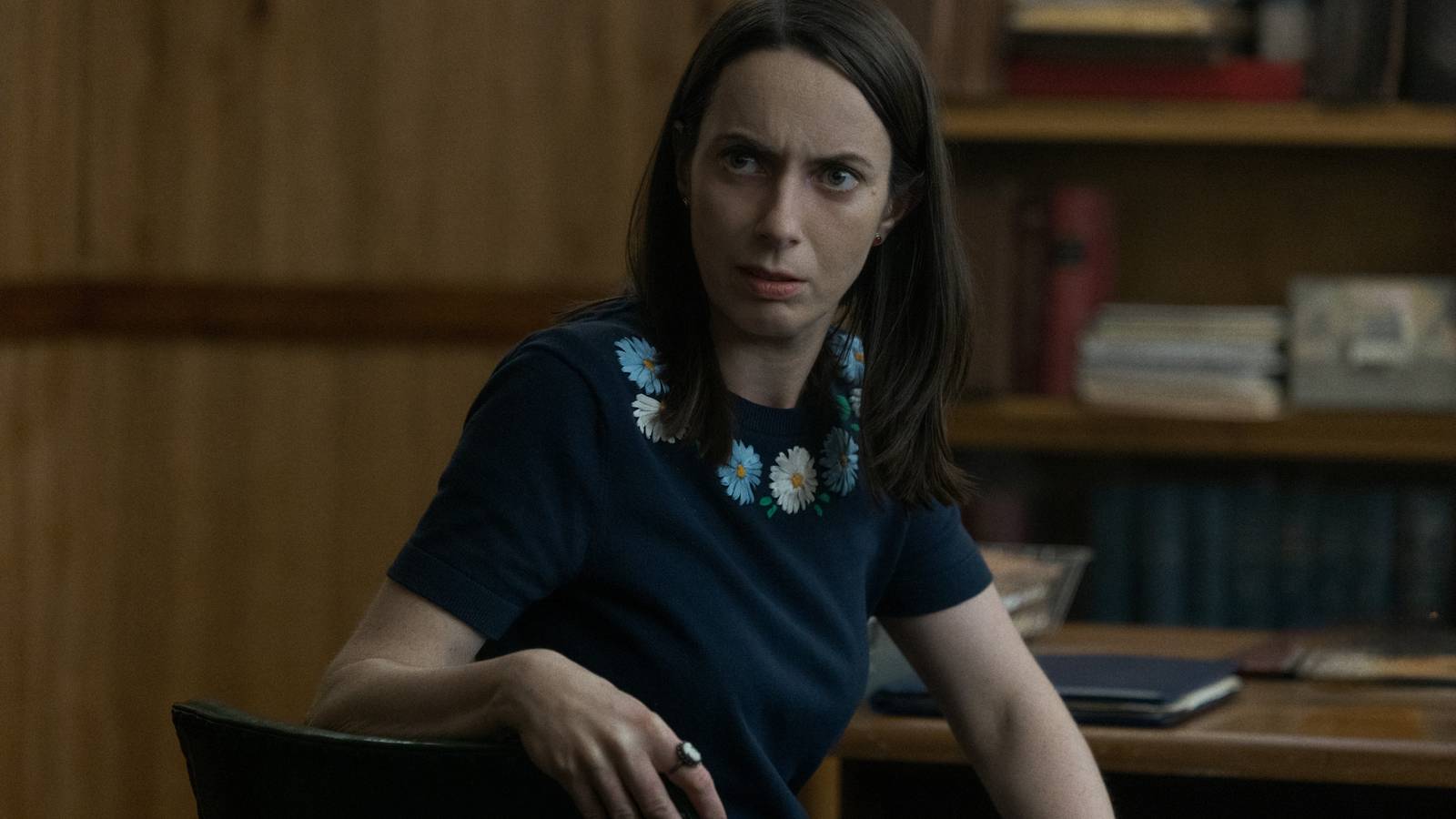
Except, they didn’t. It turns out some of Warren’s children survived, and as long as his descendents live, the curse remains. By episode 10, Loftis had traced the Warren family tree to a surprising final stop, his elderly secretary Ruth Livingston (K Callan), who never had any children of her own.
Except, she did. On a stormy night, while the rest of the town hides out in an eerie shelter, Mayor Loftis visits Ruth in her home, determined to kill her and actually end the curse. But before he can, she reveals she has a secret daughter: Tom’s dead wife, meaning that his son Evan (Kingston Rumi Southwick) is actually Warren’s last living descendant. In a tragic twist, Sheriff Bechir Clemmons (Kevin Carroll) then shows up and shoots Ruth to end the curse and save his own wife, while Tom keeps the truth about his son a secret. The storm lifts, and it seems the town of Widow’s Bay is saved — for now.
This may seem like a pretty big cliffhanger, especially for a show that only got renewed for season 2 last week, but for Murai, Widow’s Bay‘s season 1 finale also works as a conclusion to the entire story.
“I’ve always thought about this show as a story about Tom’s relationship to the town,” the director says. “The throughline for the whole season is Tom accepting that this place is what it is.”
Murai continues: “So even though we don’t get into the minutia of what ultimately that thing is underneath the island, and whether we’re going save this town or not, really the arc is whether Tom can accept the reality of this place, and if he’s willing to do what it takes to sort of protect it. To me, it felt like a satisfying character arc.”
As for whether the curse has been lifted, and if so, for how long, Murai points out that the history of Widow’s Bay is full of both peaceful and not-so-peaceful eras.
“This island has gone through cycles,” he says. “There were periods that were really bad, and then it settled down and it would become mythology, and then it would rear its head again. So even if we ended the story here, it was about this cycle of haunts.”
What does this mean for Widow’s Bay season 2?

“You’re going to have to ask Katie [Dippold] because I’ve been trying not to bother her about it,” Murai replies. “I know she’s been kind of tooling around with different ways to extend this universe and pick up where we left off.”
That said, there are some obvious loose plot threads that Murai is excited to pick up when Widow’s Bay returns.
“By the end of the season, we’re kind of resetting the table,” he says, “but Tom has the secret that he has to kind of keep from the rest of the town and, and he and Bechir have this sort of relationship now. There’s a lot to play with.”
Bonus quote: “I think everybody felt a little tense”

Behind the scenes, filming Widow’s Bay season 1 episode 10 posed an exciting challenge. In the quote below, Murai breaks down the reasons why the finale was particularly thrilling to pull off:
“Through the course of the season, we had so many set pieces and horror benchmarks we were playing with. We were doing the Halloween episode or we’re doing the Jaws episode. So there was something kind of daring but fun about making the last two episodes about the horrors of what these characters are willing to do.
“In some ways, it’s like anti-spectacle. It’s very character based and very psychological. But from a performance standpoint, that was really exciting, to just kind of trap all these characters in these confined places and then add pressure until they sort of pop.
“It created this very claustrophobic atmosphere for the actors and for the crew, because the crew was stuck in the shelter and Ruth’s house for like two weeks straight with the rain effects happening outside. It was very immersive TV-making. I think everybody felt a little tense. These scenes are tense, these locations are tense, and being in a set with like 200 other people is tense. So that’s in the show as well.”
Widow’s Bay is streaming now on Apple TV.
PakarPBN
A Private Blog Network (PBN) is a collection of websites that are controlled by a single individual or organization and used primarily to build backlinks to a “money site” in order to influence its ranking in search engines such as Google. The core idea behind a PBN is based on the importance of backlinks in Google’s ranking algorithm. Since Google views backlinks as signals of authority and trust, some website owners attempt to artificially create these signals through a controlled network of sites.
In a typical PBN setup, the owner acquires expired or aged domains that already have existing authority, backlinks, and history. These domains are rebuilt with new content and hosted separately, often using different IP addresses, hosting providers, themes, and ownership details to make them appear unrelated. Within the content published on these sites, links are strategically placed that point to the main website the owner wants to rank higher. By doing this, the owner attempts to pass link equity (also known as “link juice”) from the PBN sites to the target website.
The purpose of a PBN is to give the impression that the target website is naturally earning links from multiple independent sources. If done effectively, this can temporarily improve keyword rankings, increase organic visibility, and drive more traffic from search results.