Armored Core 2 Was Ahead of Its Time in One Important Way
There’s something strangely appropriate about how Armored Core 2 isn’t remembered with the same affection as other entries in FromSoftware’s long-running mech series. It is, after all, a game all about machines caught between old and new worlds. Released for the PlayStation 2 in October 2000, the fourth outing in the franchise (despite its name) was Armored Core’s first major step into a new generation, marking an ambitious transition that can be felt throughout the experience.
Armored Core 2 is bigger, sharper and bolder than its PlayStation predecessors, yet it remains stubbornly committed to the awkward, mechanical design philosophy that made the series so difficult to love in the first place. It lacks the mechanical refinement of Armored Core 3, the blistering speed of Armored Core: For Answer (still arguably the best among them), and the enormous resurgence that Armored Core 6: Fires of Rubicon brought to the franchise. On paper, it was exactly what a new-generation sequel should have been.
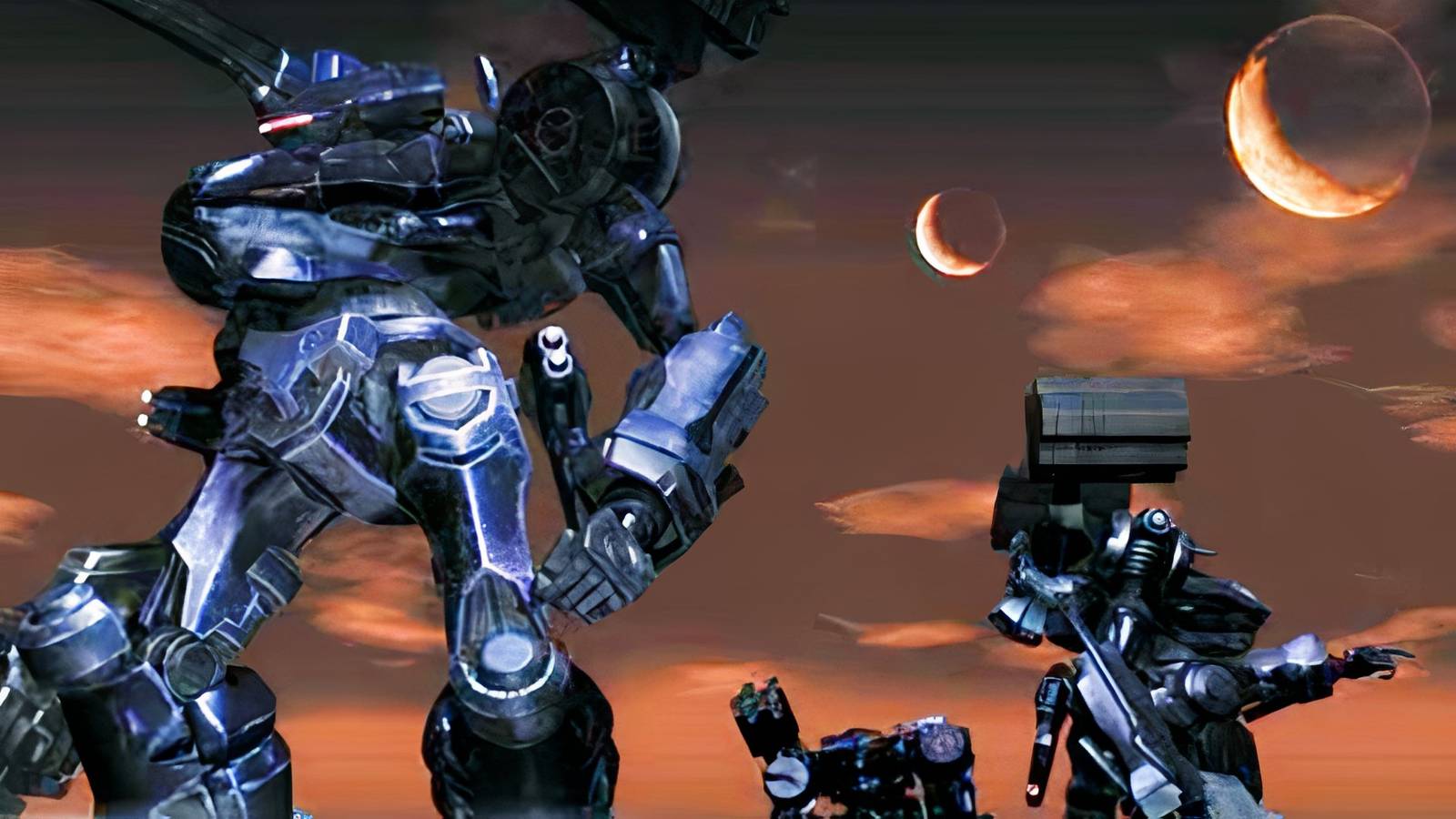
The game moves the series’ dystopian future to Mars, where three competing factions fight over the planet’s development while players act as mercenary Ravens, taking jobs from whoever is willing to pay. Across roughly 30 missions, players can work for different sides of the conflict, gradually building a more powerful Armored Core (AC) in their garage. The structure was familiar, but the scale wasn’t. Armored Core 2 offered an enormous number of weapons and parts, 50 Arena opponents and split-screen multiplayer, all wrapped in clean mech models that were genuinely impressive for an early PS2 game. Contemporary reviewers particularly praised how convincingly every customized machine moved and reacted, regardless of how radically its parts had been rearranged.
The customization remains the game’s greatest strength. Armored Core 2 understands that the fantasy isn’t simply piloting a giant robot, but building your own giant robot through immense lines of modification. Every decision in the garage changes how the machine behaves, from its weight and energy consumption to its mobility and weapon loadout. The game’s best moments happen when experimentation turns into mastery, turning a machine that looked terrible on paper into a Nine-Ball, after finally understanding how its pieces complement one another.
What holds Armored Core 2 back from its contemporaries is primarily its wonky control scheme. The decision not to embrace analog movement on the DualShock 2 was especially conspicuous in 2000. Contemporary reviews repeatedly identified the controls as the game’s biggest obstacle, while even sympathetic critics acknowledged that its stiff movement and steep learning curve could be jarring compared to more immediately accessible mech games such as Virtual-On. For veterans, that awkwardness became part of the appeal; you weren’t controlling a superhero who happened to look like a robot, but a complicated machine that took practice and precision. For newcomers, however, the distinction between deliberate mechanical weight and simply bad controls was much harder to appreciate.
When Armored Core 2 launched, the PlayStation 2 had just ushered in a massive technological leap, carrying with it an industry-wide expectation that new hardware existed primarily to deliver cinematic visual spectacles. FromSoftware, however, refused to chase that trend. In a 1999 interview with Game Hihyou magazine, studio founder Naotoshi Jin, who supervised the project alongside Toshifumi Nabeshima, openly dismissed the era’s growing obsession with movie-like experiences.
“Right now there’s this trend in the game industry, this idea that ‘if you just throw enough money and people at a project, it will be a good game,’” said Jin, “Trying to make games like movies is a mistake.”
Rather than functioning as a flashy graphical showcase for Sony’s new Emotion Engine, Armored Core 2 used the next-generation hardware to double down on an old-fashioned design philosophy. Much like Hidetaka Miyazaki would later do with Demon’s Souls on the PS3, producer Kenichiro Tsukuda delivered an uncompromising experience that expected players to study complex systems, tolerate failure, and spend just as much time meticulously tuning a machine in the menus as they did piloting it in the arena.
 Image: FromSoftware
That combination of unyielding ambition and mechanical awkwardness might explain why Armored Core 2 rarely occupies the same mythical space as later entries. It doesn’t radically reinvent the wheel the way Armored Core 4 eventually would, nor does it represent the refined, ultimate culmination of the classic PS1 formula. Instead, it exists as a fascinating, awkward middle child — a stepping stone that nonetheless pushed the franchise’s core philosophy forward.
Viewed from 2026, Armored Core 2 doesn’t just look like an archaic PS2 launch title, but as an early draft of what Armored Core 6 would inevitably perfect: dropping players into a battlefield, handing them an impossibly deep toolbox, and trusting them to figure out exactly what kind of pilot they need to become.
The controls may have aged terribly, and the visuals most certainly have, but that fundamental philosophy hasn’t aged one bit.
PakarPBN
A Private Blog Network (PBN) is a collection of websites that are controlled by a single individual or organization and used primarily to build backlinks to a “money site” in order to influence its ranking in search engines such as Google. The core idea behind a PBN is based on the importance of backlinks in Google’s ranking algorithm. Since Google views backlinks as signals of authority and trust, some website owners attempt to artificially create these signals through a controlled network of sites.
In a typical PBN setup, the owner acquires expired or aged domains that already have existing authority, backlinks, and history. These domains are rebuilt with new content and hosted separately, often using different IP addresses, hosting providers, themes, and ownership details to make them appear unrelated. Within the content published on these sites, links are strategically placed that point to the main website the owner wants to rank higher. By doing this, the owner attempts to pass link equity (also known as “link juice”) from the PBN sites to the target website.
The purpose of a PBN is to give the impression that the target website is naturally earning links from multiple independent sources. If done effectively, this can temporarily improve keyword rankings, increase organic visibility, and drive more traffic from search results.